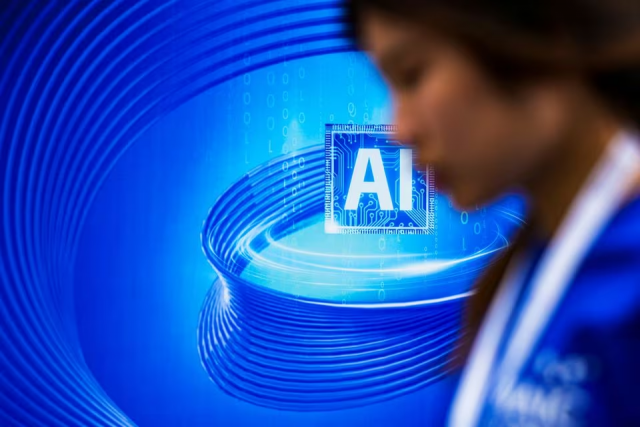
An AI (Artificial Intelligence) sign is seen at the World Artificial Intelligence Conference (WAIC) in Shanghai, China July 6, 2023. PHOTO: REUTERS/FILE
ISLAMABAD:
The government has decided to include international artificial intelligence (AI) experts in the AI council to execute Pakistan’s National Artificial Intelligence policy.
The government does not want domination by traditional bureaucracy and has decided that international AI experts should be included in the council for better implementation of the AI policy.
“This is the reason that implementation of the AI policy has been delayed,” sources said.
The National AI Policy was approved by the federal cabinet in July 2025. However, sources in the Ministry of IT and Telecom said that the federal government sought input from the provinces around a month ago on the draft AI policy.
The delay has also affected the establishment of the proposed AI Council, a central body meant to steer policy, coordination and regulation of artificial intelligence in the country. Sources said the council has yet to be notified despite being a core component of the policy framework.
The proposed AI Council is expected to include representatives from key federal ministries and regulators, including the Ministry of Science and Technology, the Ministry of Foreign Affairs and the Ministry of Federal Education, as well as the heads of the Higher Education Commission and the Pakistan Telecommunication Authority.
Officials said the council would play a critical role in aligning AI development with national priorities, regulating emerging technologies and coordinating between federal and provincial stakeholders.
Meanwhile, experts warn that Pakistan’s weak AI infrastructure poses a serious challenge. The country faces an acute shortage of high-performance computing (HPC) data centres, which are essential for advanced AI research and large-scale model development. At present, only three universities in Pakistan are reported to have functional HPC data centres.
Although telecom operators maintain data centres, sources said these facilities are largely designed for conventional IT and network operations and are insufficient for modern AI workloads.
The private sector has shown growing interest in investing in data centres, particularly for AI-related services. However, the absence of a clear government policy and regulatory framework has created uncertainty, slowing potential investment.
Analysts caution that without timely policy decisions, institutional coordination and infrastructure development, Pakistan risks falling further behind in the global race for artificial intelligence, undermining its broader digital and economic ambitions.
While the AI Council, an apex body responsible for providing strategic direction and overseeing the policy implementation process, has not been formed, the IT ministry has decided to include both local and international experts in it.
The current council structure is heavily bureaucratic, and AI experts are not included in it.